
Advanced Technology for Precision and Safety
Modern spine surgery increasingly incorporates advanced technologies such as spinal navigation and robotic-assisted surgery to improve accuracy, safety, and outcomes.
These technologies act as a real-time guidance system, helping Dr. Shlykov perform procedures with a high level of precision—particularly in complex or minimally invasive spine surgery.
What Is Spinal Navigation?
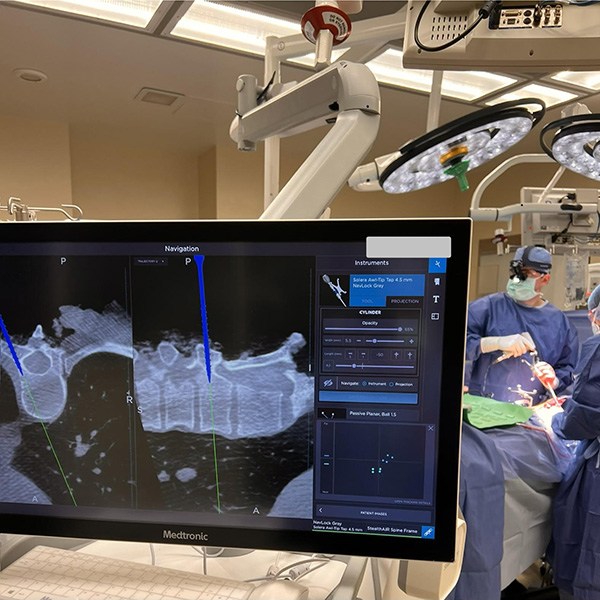
Spinal navigation is an advanced imaging and guidance system that functions like a GPS for spine surgery.
Using detailed imaging such as CT scans or intraoperative 3D imaging, the system creates a real-time, three-dimensional model of your spine.
During surgery:
- Specialized instruments are tracked in real time
- Their exact position is displayed relative to your anatomy
- This allows precise placement of screws, implants, and instruments
Navigation helps ensure that surgery is performed accurately and safely, even in complex anatomy.
What Is Robotic Spine Surgery?
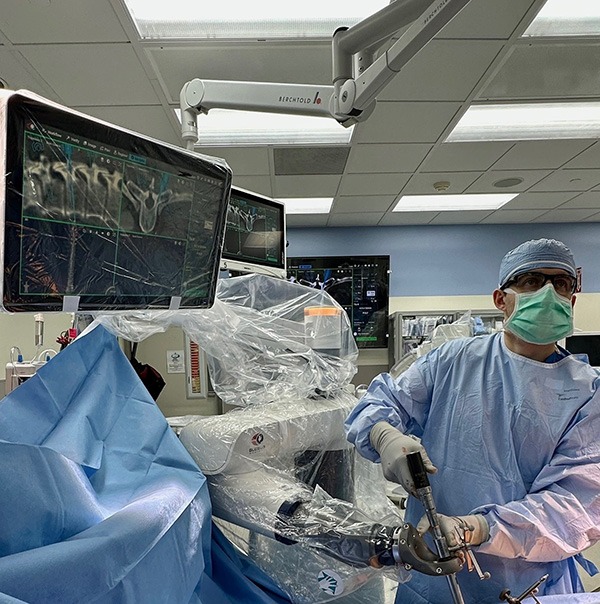
Robotic spine surgery uses a computer-assisted robotic system to help guide surgical instruments based on a preoperative plan.
It is important to understand that:
- The robot does not perform the surgery
- Dr. Shlykov remains in full control at all times
The robotic system assists by helping guide instruments along pre-planned, highly precise trajectories.
How Robotic-Assisted Surgery Works
Robotic spine surgery typically involves several steps:
Preoperative Planning
- A CT scan or 3D imaging is obtained
- A detailed surgical plan is created
- Implant size, position, and trajectory are mapped in advance
Intraoperative Setup
- A reference platform is attached to the spine
- The system aligns (or “registers”) your anatomy with the preoperative plan
Real-Time Guidance
- The robotic arm helps guide instruments to the planned location
- Navigation confirms positioning in real time
- Implant placement can be verified during surgery
When Are Navigation and Robotics Used?
These technologies are particularly useful in:
- Pedicle screw placement (cervical, thoracic, and lumbar spine)
- Minimally invasive spine surgery
- Spinal deformity correction (scoliosis, kyphosis)
- Revision spine surgery where anatomy is altered
- Spinal tumors or trauma
- Complex cervical spine procedures
They are especially valuable when precision is critical and margins for error are small.
Benefits of Navigated and Robotic Spine Surgery
Potential benefits include:
- Improved accuracy of implant placement
- Reduced risk of nerve, spinal cord, or vascular injury
- Ability to perform minimally invasive procedures
- Smaller incisions and less tissue disruption
- Reduced need for intraoperative X-ray exposure in some cases
- Real-time verification of implant positioning
These technologies help enhance both surgical precision and patient safety.
Are These Technologies Necessary for Every Surgery?
Not all spine procedures require navigation or robotic assistance.
Dr. Shlykov selects the appropriate technology based on:
- The complexity of the condition
- The anatomy involved
- The type of procedure being performed
In many cases, these tools provide an added level of precision, but the most important factor remains surgical judgment and experience.
Risks and Considerations
While these technologies are safe and widely used, there are some considerations:
- Additional setup time in some cases
- Dependence on accurate system registration
- Rare technical issues or system limitations
- Standard surgical risks (infection, bleeding, nerve injury) still apply
These systems are used to enhance safety—not replace surgical expertise.
Recovery After Navigated or Robotic Spine Surgery
Recovery is generally determined by the type of procedure performed, not the technology used.
However, because these technologies often support minimally invasive techniques, patients may experience:
- Less muscle disruption
- Smaller incisions
- Faster recovery in some cases
Summary
Spinal navigation and robotic-assisted surgery are advanced technologies that improve the precision and safety of spine procedures. By providing real-time imaging and guidance, these systems help optimize implant placement and support minimally invasive techniques. While not required for every case, they are particularly valuable in complex and high-precision procedures. Ultimately, the success of spine surgery depends on careful planning, surgical expertise, and selecting the right approach for each patient.
Considering Spine Surgery?
If you are exploring surgical options, Dr. Shlykov will determine whether navigated or robotic-assisted techniques may benefit your specific condition.
Schedule a consultation or Second Opinion to learn more about options.