

Stabilizing the Lower Back and Relieving Nerve Compression
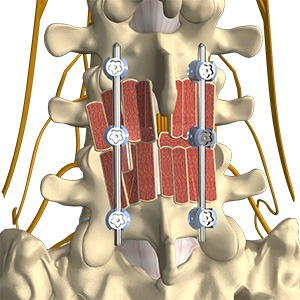
Posterior lumbar fusion is a surgical procedure used to stabilize the lower spine (lumbar spine) and relieve pressure on nerves. It is commonly performed for conditions such as spinal instability, spondylolisthesis, spinal stenosis, and degenerative disc disease.
One of the most common techniques used in posterior lumbar fusion is TLIF (Transforaminal Lumbar Interbody Fusion), which allows both decompression of nerves and restoration of disc height through a single posterior approach.
Understanding the Problem
The lumbar spine supports much of the body’s weight and allows movement such as bending and twisting.
Conditions that can lead to pain or instability include:
- Degenerative disc disease
- Spondylolisthesis (vertebral slippage)
- Spinal stenosis
- Recurrent disc herniation
- Spinal deformity
- Trauma or prior surgery
When the spine becomes unstable or nerves are compressed, patients may experience:
- Lower back pain
- Leg pain (sciatica)
- Numbness or tingling
- Weakness
- Difficulty standing or walking
What Is Posterior Lumbar Fusion?
Posterior lumbar fusion is a procedure that:
- Stabilizes the spine by joining two or more vertebrae
- Uses bone graft to promote bone healing (fusion)
- Often includes placement of screws and rods for support
Fusion eliminates motion at the affected segment, which can help reduce pain caused by instability.
What Is TLIF (Transforaminal Lumbar Interbody Fusion)?
TLIF is a specific type of posterior lumbar fusion that involves:
- Accessing the spine from the back (posterior approach)
- Removing the damaged disc through a transforaminal (side) corridor
- Placing an interbody spacer (cage) into the disc space
- Restoring disc height and opening space for the nerves
- Stabilizing the spine with screws and rods
TLIF allows for both decompression and fusion through a single approach, making it a commonly used and effective technique.
When Is Posterior Lumbar Fusion Recommended?
Fusion (including TLIF) may be recommended when:
- There is spinal instability
- Spondylolisthesis is present
- Significant back pain is related to motion at a segment
- Decompression alone would create instability
- There is recurrent disc herniation
- There is deformity or alignment issues
Surgery is typically considered after non-surgical treatments such as physical therapy, medications, and injections have not provided sufficient relief.
How the Procedure Is Performed
During posterior lumbar fusion (TLIF):
- An incision is made in the lower back
- The muscles are gently moved aside
- Nerve decompression is performed (laminectomy or foraminotomy if needed)
- The disc is partially or completely removed
- An interbody cage with bone graft is placed into the disc space
- Screws and rods are inserted to stabilize the spine
Over time, the bone graft heals and the vertebrae fuse into a solid, stable segment.
Benefits of Posterior Lumbar Fusion
Potential benefits include:
- Stabilization of the spine
- Relief of nerve compression
- Improvement in leg pain (sciatica)
- Reduction in mechanical back pain
- Restoration of disc height and alignment
In appropriately selected patients, fusion can significantly improve pain, function, and quality of life.
What the Evidence Shows
Lumbar fusion procedures, including TLIF, have been widely studied.
Research shows that:
- Patients with spondylolisthesis and instability benefit significantly from fusion
- Fusion can provide durable improvement in pain and function
- In cases where instability is present, fusion often provides better outcomes than decompression alone
Outcomes depend heavily on proper patient selection and surgical technique.
Recovery After Lumbar Fusion
Recovery is more gradual than with decompression-only procedures.
General expectations include:
- Hospital stay of 1–3 days in many cases
- Early walking after surgery
- Gradual return to activity
Typical timeline:
- Light activity: within weeks
- Return to work: often 4–12 weeks (depending on job)
- Fusion healing: occurs over several months
Detailed recovery instructions and activity guidelines are provided based on your specific procedure.
Risks and Complications
As with any spine surgery, posterior lumbar fusion carries potential risks, including:
- Infection
- Bleeding
- Nerve injury
- Dural tear (spinal fluid leak)
- Failure of fusion (pseudarthrosis)
- Hardware loosening or breakage
- Adjacent segment degeneration over time
- Persistent pain
Dr. Shlykov will discuss these risks and tailor the surgical plan to optimize outcomes.
Fusion vs Decompression Alone
In some patients, decompression alone (such as laminectomy) may be sufficient.
Fusion is typically recommended when:
- There is instability or slippage
- Significant back pain is related to motion
- Decompression would destabilize the spine
Choosing between these options depends on imaging, symptoms, and patient goals.
Summary
Posterior lumbar fusion is a well-established procedure used to stabilize the spine and relieve nerve compression in the lower back. TLIF is a commonly used technique that allows for both decompression and fusion through a single posterior approach. In appropriately selected patients, these procedures provide durable relief of pain, improved function, and long-term spinal stability.
Considering Lumbar Fusion?
If you have been diagnosed with spinal instability, spondylolisthesis, or persistent back and leg pain, a consultation can help determine whether fusion is appropriate.
Dr. Shlykov will review your imaging and symptoms to develop a personalized treatment plan tailored to your goals.
Schedule a consultation or Second Opinion to learn more about options.