

Sacroiliac Joint Anatomy
The sacroiliac (SI) joints are located where the spine meets the pelvis. These joints connect the sacrum, the triangular bone at the base of the spine, to the iliac bones of the pelvis on each side.
The SI joints are among the largest and strongest joints in the body. Their primary role is to transfer forces between the upper body and the lower body, helping to support standing, walking, and lifting activities.
Unlike many other joints, the SI joints allow only a small amount of movement. Instead, they function primarily as shock absorbers, distributing the weight and forces generated by the spine during movement.
Because of the large forces that pass through them, the SI joints can sometimes become inflamed or dysfunctional, resulting in pain.
What Is Sacroiliac Joint Dysfunction?
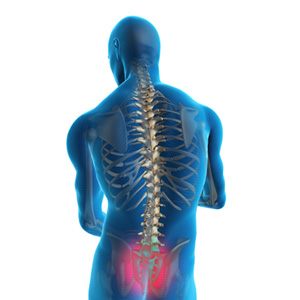
Sacroiliac joint dysfunction refers to pain that originates from irritation or abnormal movement of the SI joint.
SI joint dysfunction is a recognized cause of lower back pain and may account for 15–30% of chronic low back pain cases.
Pain from the SI joint can sometimes mimic other spinal conditions such as disc herniation, sciatica, or lumbar spine arthritis, which can make diagnosis challenging.
Causes of Sacroiliac Joint Dysfunction
Several factors can contribute to SI joint dysfunction.
Traumatic Injury
Sudden impacts such as falls, motor vehicle accidents, or sports injuries can damage the ligaments supporting the SI joint.
Biomechanical Imbalance
Abnormal alignment of the pelvis or spine may increase stress on the SI joint. Examples include:
- Leg length differences
- Pelvic rotation
- Muscle imbalance
Degenerative Changes
Arthritis and degenerative changes in the SI joint can cause inflammation and pain.
Pregnancy
Hormonal changes during pregnancy cause ligaments to become more flexible in preparation for childbirth. This increased ligament laxity can lead to SI joint instability and pain.
Inflammatory Conditions
Certain inflammatory diseases may affect the SI joints, including:
- Ankylosing spondylitis
- Psoriatic arthritis
- Other inflammatory arthropathies
Prior Lumbar Fusion
In some patients, SI joint pain may develop after lumbar spinal fusion surgery due to increased mechanical stress transferred to the pelvis.
Symptoms of Sacroiliac Joint Dysfunction
The most common symptom of SI joint dysfunction is pain in the lower back or buttock region.
Pain may also radiate to other areas, including:
- Buttocks
- Upper thigh
- Groin
- Occasionally down the leg
Other symptoms may include:
- Pain that worsens with standing or walking
- Pain when climbing stairs or transitioning from sitting to standing
- Difficulty sitting for long periods
- Limping or altered walking pattern
- Limited mobility in the lower back or pelvis
Unlike nerve-related pain, SI joint pain usually does not extend below the knee.
Diagnosis
Proper diagnosis of SI joint dysfunction is important because symptoms can resemble other spinal conditions such as lumbar disc herniation or spinal stenosis.
Diagnosis typically includes:
Medical History and Physical Examination
Your physician will evaluate:
- Location of pain
- Spinal and pelvic alignment
- Range of motion
- Specific physical exam maneuvers that stress the SI joint
Imaging Studies
Imaging tests may be used to rule out other causes of pain. These may include:
- X-rays
- MRI scans
- CT scans
Diagnostic Injections
In some cases, a diagnostic SI joint injection using a local anesthetic may be performed. If the injection significantly relieves pain, it suggests that the SI joint is the source of symptoms.
Treatment
Treatment for SI joint dysfunction typically begins with conservative, non-surgical approaches.
Non-Surgical Treatment
Common treatments include:
- Physical Therapy: Exercises aimed at strengthening the core, pelvis, and hip muscles can improve stability and reduce stress on the SI joint.
- Activity Modification: Avoiding movements that aggravate symptoms can help reduce inflammation.
- Medications: Anti-inflammatory medications may be used to reduce pain and swelling.
- SI Joint Belt: A pelvic stabilization belt may help support the SI joint and reduce motion that causes pain.
- Injections: Corticosteroid injections into the SI joint may help reduce inflammation and provide pain relief.
- Radiofrequency Ablation: In some cases, a procedure called radiofrequency ablation may be used to disrupt the small nerves that transmit pain signals from the SI joint.
Surgical Treatment
Surgery is typically considered only when conservative treatments fail to relieve symptoms.
The most common surgical procedure for severe SI joint dysfunction is minimally invasive SI joint fusion.
During this procedure, small implants are placed across the SI joint to stabilize the joint and reduce painful motion.
Minimally invasive SI joint fusion is performed through small incisions and is designed to stabilize the joint while minimizing disruption to the surrounding tissues. In certain situations—such as during posterior lumbar spinal deformity correction surgery—SI joint fusion may also be performed as part of a larger spinal reconstruction. In these cases, screws and rods may extend into the pelvis across the SI joint to provide additional support and stability to the spine, particularly when correcting complex spinal deformities.
Summary
Sacroiliac joint dysfunction is a common cause of lower back and buttock pain that occurs when the SI joint becomes inflamed or unstable. Because symptoms can mimic other spinal conditions, careful evaluation is necessary to establish an accurate diagnosis. Most patients improve with conservative treatments such as physical therapy, medications, or injections. In cases where symptoms persist despite non-surgical treatment, minimally invasive SI joint fusion may be considered to stabilize the joint and relieve pain.